

時間を節約してYouTube動画から重要なアイデアを取得
時間を節約してYouTube動画から重要なアイデアを取得
YouTubeの動画とポッドキャストの瞬時トランスクリプションとAIサマリー
Transcript
Summary
EN
Short Description:
Tal Ben-Shahar explains that true happiness isn’t about avoiding pain but embracing challenges to grow stronger — a concept called antifragility. Instead of directly chasing happiness, which can backfire, we should focus on five key areas: spiritual purpose, physical recovery, intellectual curiosity, strong relationships, and emotional resilience. By cultivating these, we indirectly increase happiness and learn to make the best of life's hardships.
Timestamped Summary:
00:00 - 00:26 – Happiness Misconception: Painful emotions are unavoidable; only psychopaths or the dead feel no pain. Happiness doesn’t mean constant
Transcript
Summary
EN
Short Description:
Tal Ben-Shahar explains that true happiness isn’t about avoiding pain but embracing challenges to grow stronger — a concept called antifragility. Instead of directly chasing happiness, which can backfire, we should focus on five key areas: spiritual purpose, physical recovery, intellectual curiosity, strong relationships, and emotional resilience. By cultivating these, we indirectly increase happiness and learn to make the best of life's hardships.
Timestamped Summary:
00:00 - 00:26 – Happiness Misconception: Painful emotions are unavoidable; only psychopaths or the dead feel no pain. Happiness doesn’t mean constant



ScripsynのAIでYouTubeを最大活用
ScripsynのAIでYouTubeを最大活用
ScripsynのAIでYouTubeを最大活用


YouTubeの動画を無料でトランスクリプト
YouTubeの動画を無料でトランスクリプト
正確なタイムスタンプ付きの超高速トランスクリプション — 1秒以内
正確なタイムスタンプ付きの超高速トランスクリプション — 1秒以内
Transcript
Summary
EN
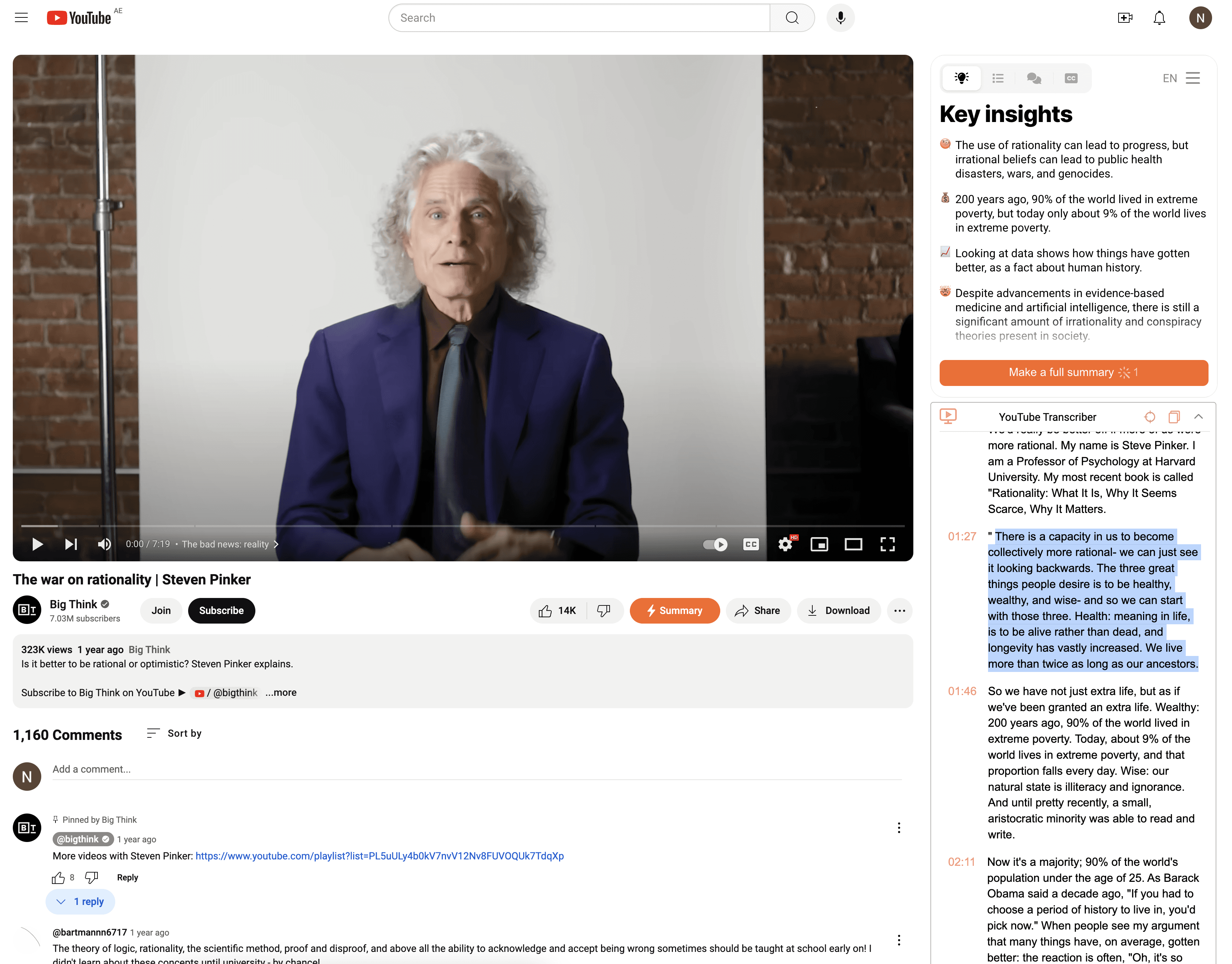
00:00
A question that I often get is: Do you believe in progress? Well, I don't believe in progress, at least not as a force in the Universe. To quote Fran Lebowitz, "I don't believe in anything you have to believe in." Because there isn't any arc bending toward justice. There is no force that's lifting us ever upward.
00:18
Quite the contrary. The Universe often seems to be out to get us. There are parasites that want to eat us from the inside. There's the laws of entropy: there are more ways for things to go wrong than to go right. There's human nature: we were not selected by the processes of evolution to be particularly nice.
00:36
We have the capacity for revenge and exploitation. So that's what's lined up against us. But nonetheless, progress has happened. How do we explain that? What might seem like a miracle? The answer is 'rationality.' If people deploy their rationality, their cognition, their language_with the goal of making other people better off- then the result, over time, is what we call 'progress.
00:59
Can we become more rational? It's a pressing question because irrational beliefs lead to public health disasters. They can lead to wars and genocides. We'd really be better off if more of us were more rational. My name is Steve Pinker. I am a Professor of Psychology at Harvard University. My most recent book is called "Rationality: What It Is, Why It Seems Scarce, Why It Matters.
01:27
There is a capacity in us to become collectively more rational — we can just see it looking backwards. The three great things people desire is to be healthy, wealthy, and wise- and so we can start with those three. Health: meaning in life, is to be alive rather than dead, and longevity has vastly increased. We live more than twice as long as our ancestors.
01:46
So we have not just extra life, but as if we've been granted an extra life. Wealthy: 200 years ago, 90% of the world lived in extreme poverty. Today, about 9% of the world lives in extreme poverty, and that proportion falls every day. Wise: our natural state is illiteracy and ignorance. And until pretty recently, a small, aristocratic minority was able to read and write.

Transcript
Summary
EN
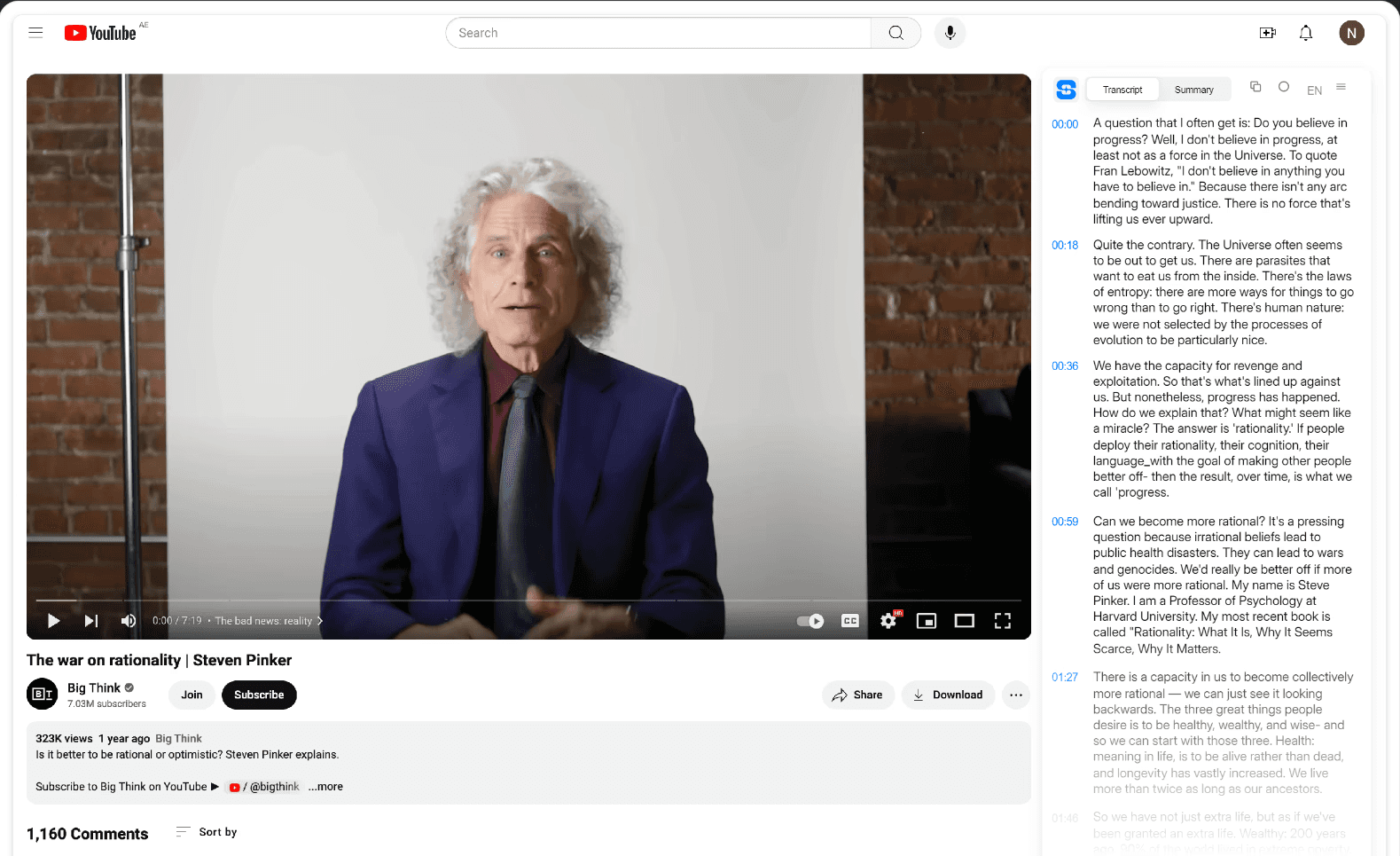
00:00
A question that I often get is: Do you believe in progress? Well, I don't believe in progress, at least not as a force in the Universe. To quote Fran Lebowitz, "I don't believe in anything you have to believe in." Because there isn't any arc bending toward justice. There is no force that's lifting us ever upward.
00:18
Quite the contrary. The Universe often seems to be out to get us. There are parasites that want to eat us from the inside. There's the laws of entropy: there are more ways for things to go wrong than to go right. There's human nature: we were not selected by the processes of evolution to be particularly nice.
00:36
We have the capacity for revenge and exploitation. So that's what's lined up against us. But nonetheless, progress has happened. How do we explain that? What might seem like a miracle? The answer is 'rationality.' If people deploy their rationality, their cognition, their language_with the goal of making other people better off- then the result, over time, is what we call 'progress.
00:59
Can we become more rational? It's a pressing question because irrational beliefs lead to public health disasters. They can lead to wars and genocides. We'd really be better off if more of us were more rational. My name is Steve Pinker. I am a Professor of Psychology at Harvard University. My most recent book is called "Rationality: What It Is, Why It Seems Scarce, Why It Matters.
01:27
There is a capacity in us to become collectively more rational — we can just see it looking backwards. The three great things people desire is to be healthy, wealthy, and wise- and so we can start with those three. Health: meaning in life, is to be alive rather than dead, and longevity has vastly increased. We live more than twice as long as our ancestors.
01:46
So we have not just extra life, but as if we've been granted an extra life. Wealthy: 200 years ago, 90% of the world lived in extreme poverty. Today, about 9% of the world lives in extreme poverty, and that proportion falls every day. Wise: our natural state is illiteracy and ignorance. And until pretty recently, a small, aristocratic minority was able to read and write.
Transcript
Summary
EN
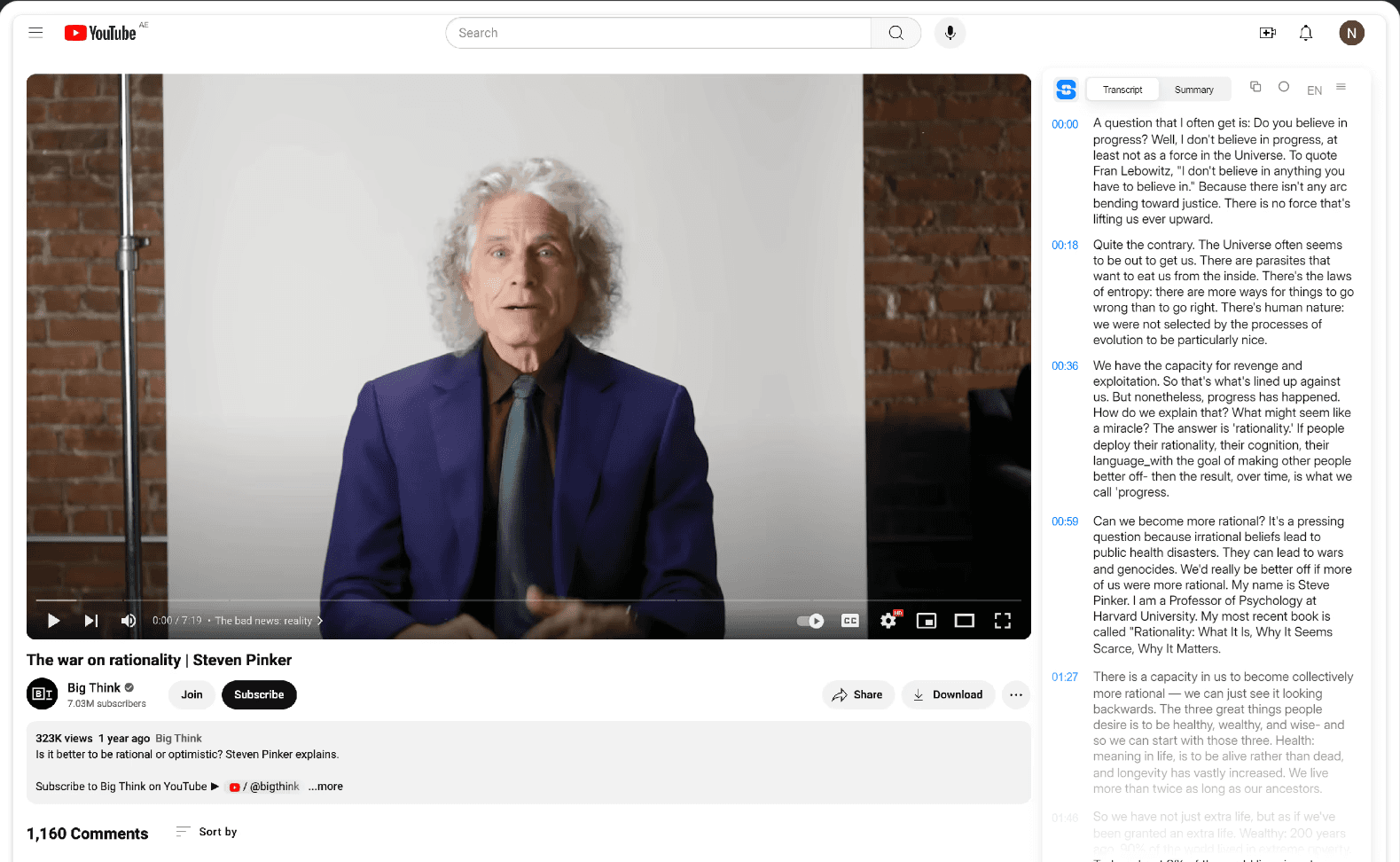
00:00
A question that I often get is: Do you believe in progress? Well, I don't believe in progress, at least not as a force in the Universe. To quote Fran Lebowitz, "I don't believe in anything you have to believe in." Because there isn't any arc bending toward justice. There is no force that's lifting us ever upward.
00:18
Quite the contrary. The Universe often seems to be out to get us. There are parasites that want to eat us from the inside. There's the laws of entropy: there are more ways for things to go wrong than to go right. There's human nature: we were not selected by the processes of evolution to be particularly nice.
00:36
We have the capacity for revenge and exploitation. So that's what's lined up against us. But nonetheless, progress has happened. How do we explain that? What might seem like a miracle? The answer is 'rationality.' If people deploy their rationality, their cognition, their language_with the goal of making other people better off- then the result, over time, is what we call 'progress.
00:59
Can we become more rational? It's a pressing question because irrational beliefs lead to public health disasters. They can lead to wars and genocides. We'd really be better off if more of us were more rational. My name is Steve Pinker. I am a Professor of Psychology at Harvard University. My most recent book is called "Rationality: What It Is, Why It Seems Scarce, Why It Matters.
01:27
There is a capacity in us to become collectively more rational — we can just see it looking backwards. The three great things people desire is to be healthy, wealthy, and wise- and so we can start with those three. Health: meaning in life, is to be alive rather than dead, and longevity has vastly increased. We live more than twice as long as our ancestors.
01:46
So we have not just extra life, but as if we've been granted an extra life. Wealthy: 200 years ago, 90% of the world lived in extreme poverty. Today, about 9% of the world lives in extreme poverty, and that proportion falls every day. Wise: our natural state is illiteracy and ignorance. And until pretty recently, a small, aristocratic minority was able to read and write.

数秒でYouTube動画を要約
数秒でYouTube動画を要約
AIによる正確なサマリーで、長い動画やポッドキャストの時間を節約
AIによる正確なサマリーで、長い動画やポッドキャストの時間を節約
Transcript
Summary
EN
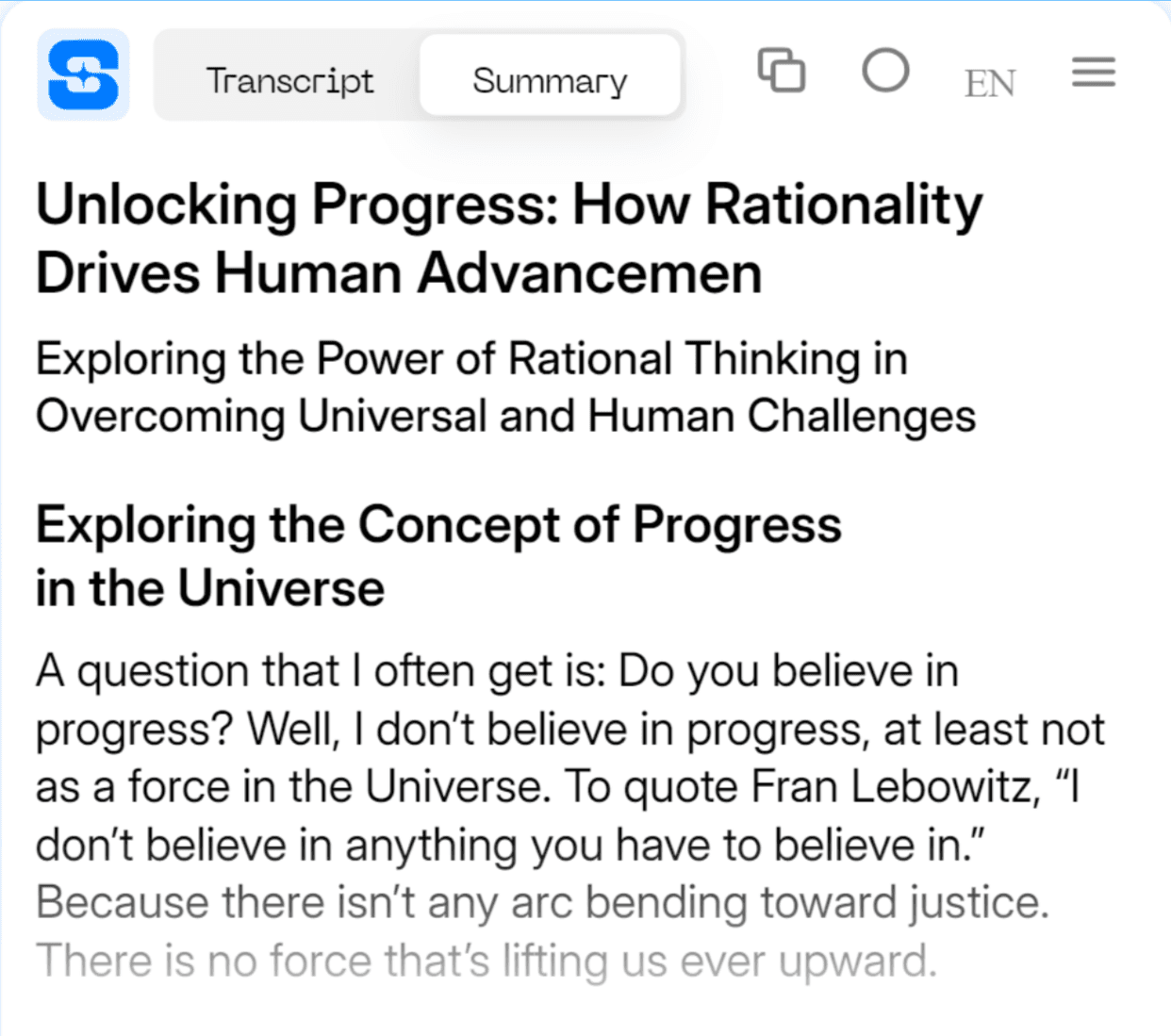
Unlocking Progress: How Rationality Drives Human Advancemen
Exploring the Power of Rational Thinking in Overcoming Universal and Human Challenges
Exploring the Concept of Progress
in the Universe
A question that I often get is: Do you believe in progress? Well, I don’t believe in progress, at least not as a force in the Universe. To quote Fran Lebowitz, “I don’t believe in anything you have to believe in.” Because there isn’t any arc bending toward justice. There is no force that’s lifting us ever upward.
Challenges from Natural and Human Forces
Quite the contrary. The Universe often seems to be out to get us. There are parasites that want to eat us from the inside. There’s the laws of entropy: there are more ways for things to go wrong than to go right. There’s human nature: we were not selected by the processes of evolution to be particularly nice. We have the capacity for revenge and exploitation. So that’s what’s lined up against us.
How Rationality Explains Human Advancement
But nonetheless, progress has happened. How do we explain that? What might seem like a miracle? The answer is ‘rationality.’ If people deploy their rationality, their cognition, their language with the goal of making other people better off, then the result, over time, is what we call ‘progress.’
Post-Match Thoughts
• Reflections on the outcome and what it means for both teams moving forward.
• Speculation on how Team Liquid will fare against Gladiators in the grand final.
• Insights into the overall strategies and adjustments that may be needed for future matches.
Player and Team Dynamics
• Discussion on the mentality and preparation of players, including anecdotes about personal experiences and team dynamics.
• Mention of the importance of hygiene and professionalism in a team environment.
• Insights into how different players handle pressure and contribute to their team’s success.
Transcript
Summary
EN
Unlocking Progress: How Rationality Drives Human Advancemen
Exploring the Power of Rational Thinking in Overcoming Universal and Human Challenges
Exploring the Concept of Progress
in the Universe
A question that I often get is: Do you believe in progress? Well, I don’t believe in progress, at least not as a force in the Universe. To quote Fran Lebowitz, “I don’t believe in anything you have to believe in.” Because there isn’t any arc bending toward justice. There is no force that’s lifting us ever upward.
Challenges from Natural and Human Forces
Quite the contrary. The Universe often seems to be out to get us. There are parasites that want to eat us from the inside. There’s the laws of entropy: there are more ways for things to go wrong than to go right. There’s human nature: we were not selected by the processes of evolution to be particularly nice. We have the capacity for revenge and exploitation. So that’s what’s lined up against us.
How Rationality Explains Human Advancement
But nonetheless, progress has happened. How do we explain that? What might seem like a miracle? The answer is ‘rationality.’ If people deploy their rationality, their cognition, their language with the goal of making other people better off, then the result, over time, is what we call ‘progress.’
Post-Match Thoughts
• Reflections on the outcome and what it means for both teams moving forward.
• Speculation on how Team Liquid will fare against Gladiators in the grand final.
• Insights into the overall strategies and adjustments that may be needed for future matches.
Player and Team Dynamics
• Discussion on the mentality and preparation of players, including anecdotes about personal experiences and team dynamics.
• Mention of the importance of hygiene and professionalism in a team environment.
• Insights into how different players handle pressure and contribute to their team’s success.
Transcript
Summary
EN
Unlocking Progress: How Rationality Drives Human Advancemen
Exploring the Power of Rational Thinking in Overcoming Universal and Human Challenges
Exploring the Concept of Progress
in the Universe
A question that I often get is: Do you believe in progress? Well, I don’t believe in progress, at least not as a force in the Universe. To quote Fran Lebowitz, “I don’t believe in anything you have to believe in.” Because there isn’t any arc bending toward justice. There is no force that’s lifting us ever upward.
Challenges from Natural and Human Forces
Quite the contrary. The Universe often seems to be out to get us. There are parasites that want to eat us from the inside. There’s the laws of entropy: there are more ways for things to go wrong than to go right. There’s human nature: we were not selected by the processes of evolution to be particularly nice. We have the capacity for revenge and exploitation. So that’s what’s lined up against us.
How Rationality Explains Human Advancement
But nonetheless, progress has happened. How do we explain that? What might seem like a miracle? The answer is ‘rationality.’ If people deploy their rationality, their cognition, their language with the goal of making other people better off, then the result, over time, is what we call ‘progress.’
Post-Match Thoughts
• Reflections on the outcome and what it means for both teams moving forward.
• Speculation on how Team Liquid will fare against Gladiators in the grand final.
• Insights into the overall strategies and adjustments that may be needed for future matches.
Player and Team Dynamics
• Discussion on the mentality and preparation of players, including anecdotes about personal experiences and team dynamics.
• Mention of the importance of hygiene and professionalism in a team environment.
• Insights into how different players handle pressure and contribute to their team’s success.

重要なアイデアとインサイトを素早く取得
重要なアイデアとインサイトを素早く取得
YouTubeの動画の重要なアイデアを、よく構成された段落に整理
YouTubeの動画の重要なアイデアを、よく構成された段落に整理
Transcript
Summary
new
EN
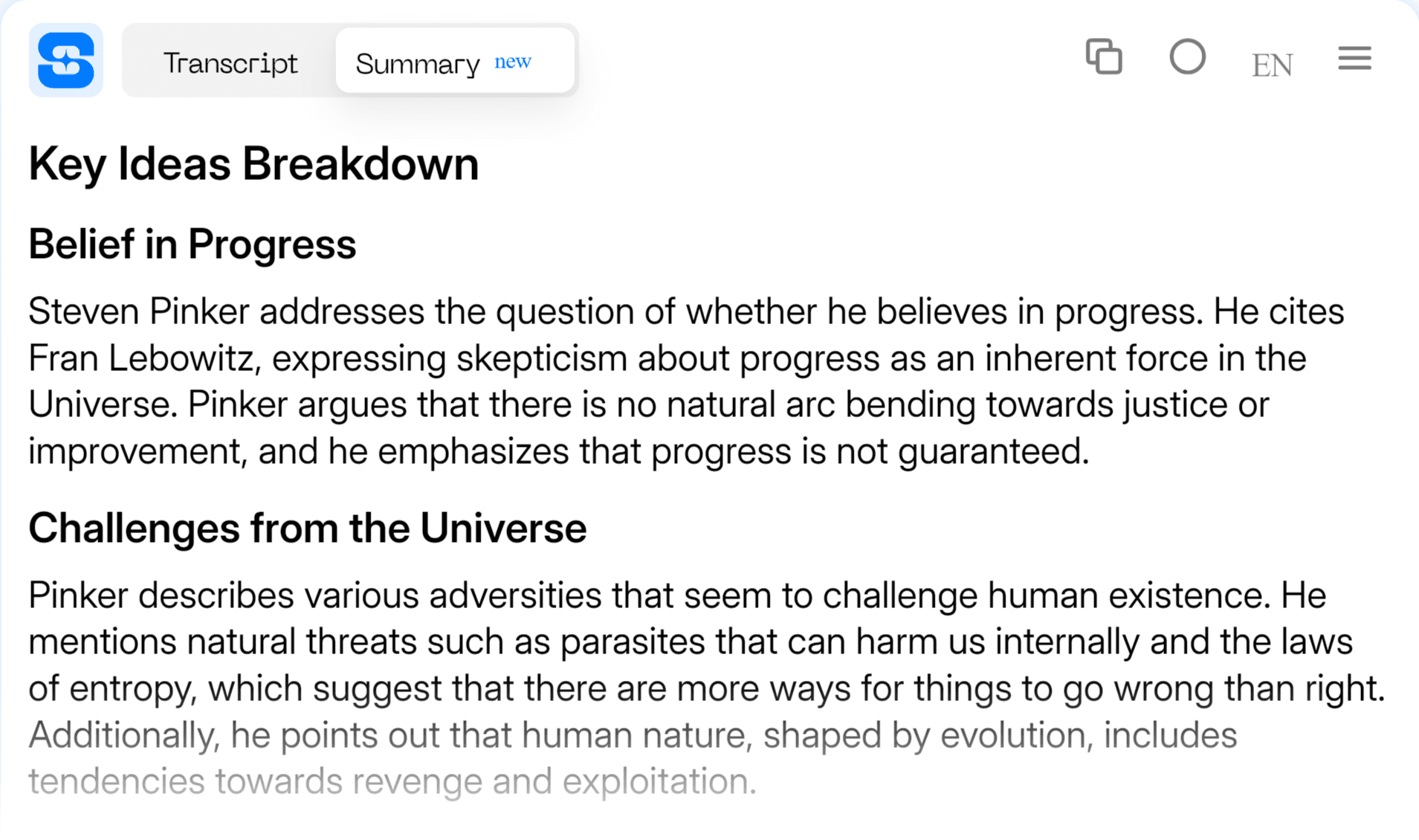
Key Ideas Breakdown
Belief in Progress
Steven Pinker addresses the question of whether he believes in progress. He cites Fran Lebowitz, expressing skepticism about progress as an inherent force in the Universe. Pinker argues that there is no natural arc bending towards justice or improvement, and he emphasizes that progress is not guaranteed.
Challenges from the Universe
Pinker describes various adversities that seem to challenge human existence. He mentions natural threats such as parasites that can harm us internally and the laws of entropy, which suggest that there are more ways for things to go wrong than right. Additionally, he points out that human nature, shaped by evolution, includes tendencies towards revenge and exploitation.
Transcript
Summary
new
EN
Key Ideas Breakdown
Belief in Progress
Steven Pinker addresses the question of whether he believes in progress. He cites Fran Lebowitz, expressing skepticism about progress as an inherent force in the Universe. Pinker argues that there is no natural arc bending towards justice or improvement, and he emphasizes that progress is not guaranteed.
Challenges from the Universe
Pinker describes various adversities that seem to challenge human existence. He mentions natural threats such as parasites that can harm us internally and the laws of entropy, which suggest that there are more ways for things to go wrong than right. Additionally, he points out that human nature, shaped by evolution, includes tendencies towards revenge and exploitation.
Transcript
Summary
new
EN
Key Ideas Breakdown
Belief in Progress
Steven Pinker addresses the question of whether he believes in progress. He cites Fran Lebowitz, expressing skepticism about progress as an inherent force in the Universe. Pinker argues that there is no natural arc bending towards justice or improvement, and he emphasizes that progress is not guaranteed.
Challenges from the Universe
Pinker describes various adversities that seem to challenge human existence. He mentions natural threats such as parasites that can harm us internally and the laws of entropy, which suggest that there are more ways for things to go wrong than right. Additionally, he points out that human nature, shaped by evolution, includes tendencies towards revenge and exploitation.


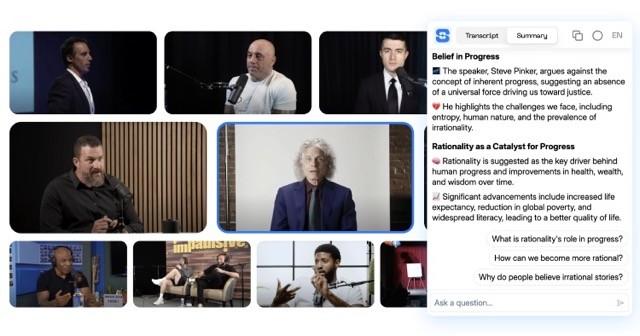
動画とチャットして、必要な答えをすぐに取得
動画とチャットして、必要な答えをすぐに取得
動画全体を見なくても、質問するだけで重要なポイント、要約、インサイトをすばやく取得できます。
動画全体を見なくても、質問するだけで重要なポイント、要約、インサイトをすばやく取得できます。
50以上の言語でトランスクリプトとサマリー
50以上の言語でトランスクリプトとサマリー
字幕で利用可能なすべての言語でトランスクリプションとサマリーを取得
字幕で利用可能なすべての言語でトランスクリプションとサマリーを取得
🇬🇧 English
🇨🇳 Mandarin Chinese
🇪🇸 Spanish
🇪🇸 Spanish
🇮🇳 Hindi
🇵🇹 Portuguese
🇯🇵 Japanese
🇫🇷 French
🇩🇪 German
🇰🇷 Korean
🇰🇷 Korean
🇺🇦 Ukrainian
🇹🇷 Turkish
🇨🇳 Mandarin Chinese
🇨🇳 Mandarin Chinese
Chromeに追加
ScripsynがNo.1評価を獲得した理由:ユーザーレビュー
Reviews
ScripsynがNo.1評価を獲得した理由:ユーザーレビュー

Scripsyのおかげで、YouTubeのコンテンツの楽しみ方が完全に変わりました。文字起こしと要約機能のおかげで、ものすごく時間を節約できています!

田中 彩
この拡張機能をありがとうございます!美しいインターフェースで使いやすく、インストールも簡単です。YouTubeを仕事や勉強に使う人には必須です。

Yuko Suzuki
これまでで最高の同種の拡張機能です!本当にありがとうございます。これからも素晴らしい仕事を続けてください!💪🏻🔥

中村 健一
さらに口コミを読む
よくある質問
よくある質問
Scripsy AIとは何ですか?
Scripsy Chrome拡張機能のインストール方法は?
Scripsyは無料で使えますか?
無制限サマリーのトライアルはありますか?
YouTubeの文字起こしや要約を複数の言語に翻訳することはできますか?
どのような動画を文字起こしできますか?
他のブラウザでもScripsyは使えますか?
この拡張機能をビジネス用途で使用することは可能ですか?提携について、どのようにご連絡すればよろしいでしょうか?


